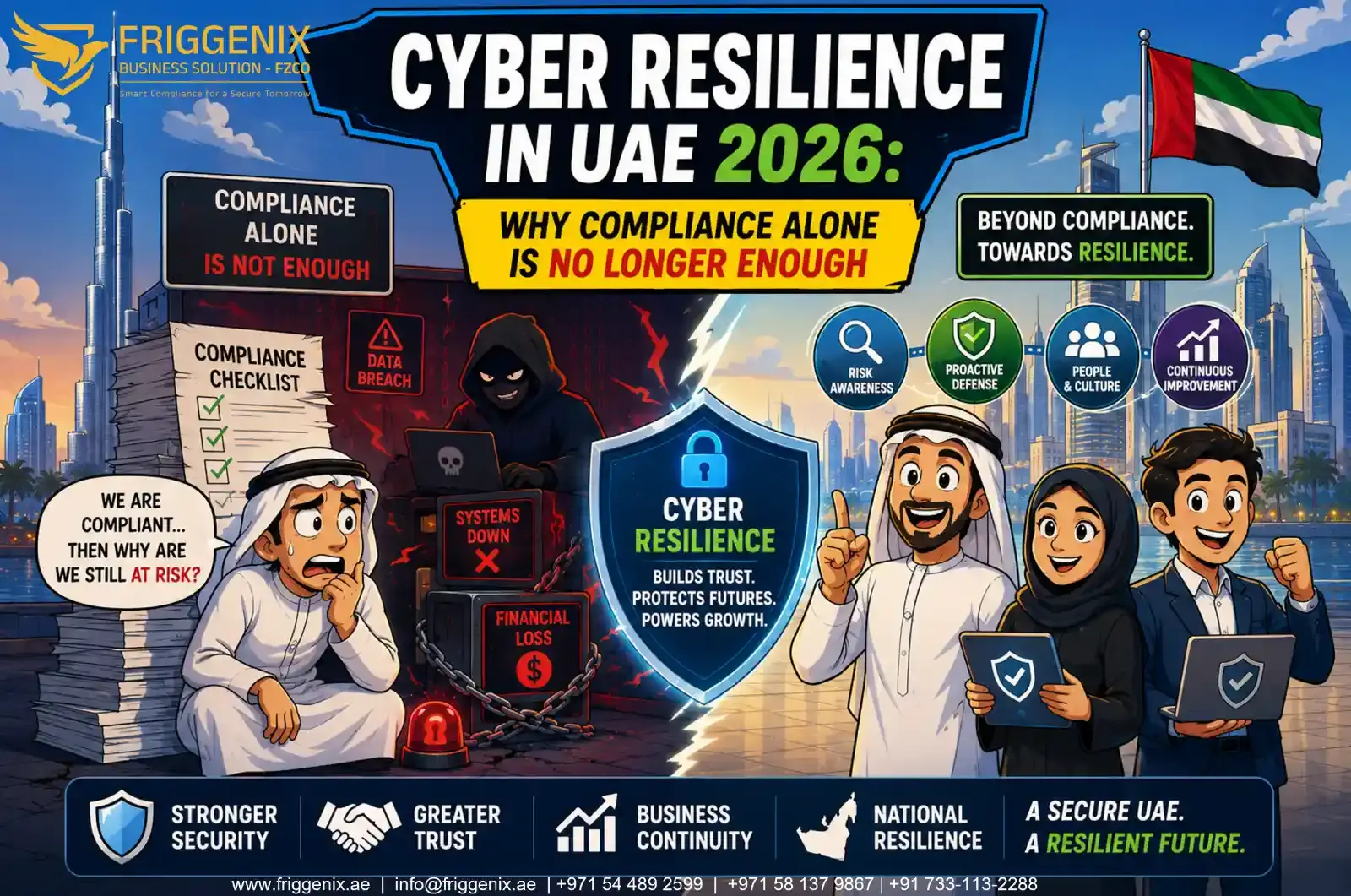
Compliance Is Dead. Resilience Is the New Standard.
UAE Regulators No Longer Want Policies. They Want Proof.
For years, organizations measured cybersecurity success through audits, certifications, and compliance reports. If policies were documented, controls were implemented, and audit findings were closed, many organizations considered themselves secure.
The cyber threat landscape has exposed the limitations of that approach.
Today, attackers are not interested in whether an organization passed its most recent audit. They are focused on disrupting operations, encrypting critical systems, stealing sensitive data, and exploiting weaknesses across increasingly complex digital ecosystems.
In this environment, compliance alone offers little protection.
The organizations that survive major cyber incidents are rarely the ones with the thickest policy manuals. They are the organizations that can detect, respond, recover, and continue operating under pressure.
That is resilience.
Why Regulators Are Changing Their Expectations
Across the UAE, regulatory authorities are placing greater emphasis on operational resilience and cyber readiness. Frameworks such as the UAE Information Assurance Standard and evolving sector-specific security requirements reflect a broader shift in regulatory thinking.
The focus is moving beyond documentation and toward demonstrable capability.
Regulators increasingly want evidence that organizations can withstand cyber incidents, recover critical operations, and maintain essential services even during periods of disruption.
This evolution reflects a simple reality: compliance does not guarantee resilience.
An organization may meet every regulatory requirement and still suffer significant operational and financial damage from a cyberattack.
The New Face of Business Risk
Cybersecurity incidents are no longer isolated technology events. They have become enterprise-wide business risks.
A successful ransomware attack can halt production, interrupt customer services, trigger regulatory investigations, damage stakeholder confidence, and create long-term reputational consequences. In many cases, the operational impact exceeds the direct financial losses.
What makes the challenge even more complex is that modern organizations rarely operate in isolation.
Cloud providers, software vendors, managed service providers, and outsourced business functions all form part of a connected ecosystem. A weakness anywhere within that ecosystem can quickly become a problem for everyone.
As a result, resilience is no longer just about protecting internal systems. It is about understanding and managing risk across the entire digital supply chain.
Why Boards Are Becoming More Involved
Cybersecurity discussions have traditionally been delegated to IT departments and technical teams. That model is changing rapidly.
Board members and executive leadership teams are increasingly expected to understand cyber risks, oversee resilience strategies, and ensure appropriate governance structures are in place.
Investors, regulators, customers, and business partners now view cyber resilience as an indicator of organizational maturity.
The ability to demonstrate preparedness, responsiveness, and recovery capability is becoming as important as demonstrating financial stability or regulatory compliance.
This shift is elevating cybersecurity from a technical function to a core governance responsibility.
Building a Culture of Resilience
True resilience is not achieved through technology alone.
It requires a combination of governance, risk management, continuous monitoring, incident preparedness, employee awareness, and executive accountability.
Organizations that invest in resilience understand that cyber incidents are not a matter of if, but when.
Their objective is not merely to prevent attacks. Their objective is to ensure the business can continue operating when attacks occur.
That mindset fundamentally changes how organizations approach cybersecurity.
Instead of focusing solely on preventing failure, they focus on minimizing disruption and accelerating recovery.
Looking Ahead
The future of cybersecurity will not be defined by compliance scores or audit outcomes.
It will be defined by resilience.
Organizations that can demonstrate their ability to withstand disruption, recover quickly, and protect critical operations will be better positioned to meet regulatory expectations and maintain stakeholder confidence.
In a world where cyber threats continue to evolve, resilience is no longer a competitive advantage.
It is becoming a business necessity.
About Friggenix Business Solutions
Friggenix Business Solution helps organizations strengthen cyber resilience through governance frameworks, risk assessments, cybersecurity compliance programs, operational resilience initiatives, third-party risk management, and continuous assurance strategies.
If your organization is seeking to move beyond compliance and build sustainable cyber resilience, our team can help.
Website: https://friggenix.ae
Email: support@friggenix.ae
References
-
KPMG UAE – A Bold Step Towards Cyber Resilience: UAE Information Assurance Standard v2.1
https://assets.kpmg.com/content/dam/kpmgsites/ae/pdf/a-bold-step-towards-cyber-resilience.pdf -
Chambers & Partners – UAE Cybersecurity Trends and Developments 2026
https://practiceguides.chambers.com/practice-guides/cybersecurity-2026/uae/trends-and-developments -
Complyan – How Dubai’s ISR 3.0 is Shaping Smarter Security Standards
https://complyan.com/how-dubais-isr-v3-0-is-shaping-smarter-security-standards-in-the-region/
Disclaimer: The incidents referenced in this article are based on publicly reported information, regulatory findings, and official organizational statements available at the time of writing. The purpose of these examples is educational and informational, highlighting cybersecurity, privacy, and business resilience lessons for organizations.
About the Authors
Harini Pallavi
Harini Pallavi is a Senior Leader with over 15 years of experience in Internal Audit, Cybersecurity, Information Security, Risk management, and Data Privacy, with a strong focus on the UAE Regulatory and Compliance Landscape. She has led Audit and Assurance initiatives across highly regulated sectors, aligning programs with UAE PDPL, DIFC, ADGM, and DESC requirements, as well as Global Standards such as ISO, NIST, and GDPR.
She works closely with Executive Leadership, Regulators, and Boards in the UAE to deliver independent Compliance and Regulatory Assurance with actionable insights. She holds multiple global professional certifications supported by an MBA, with a proven track record of building high-performing teams and strengthening Governance Frameworks.
LinkedIn: Harini Pallavi | LinkedIn