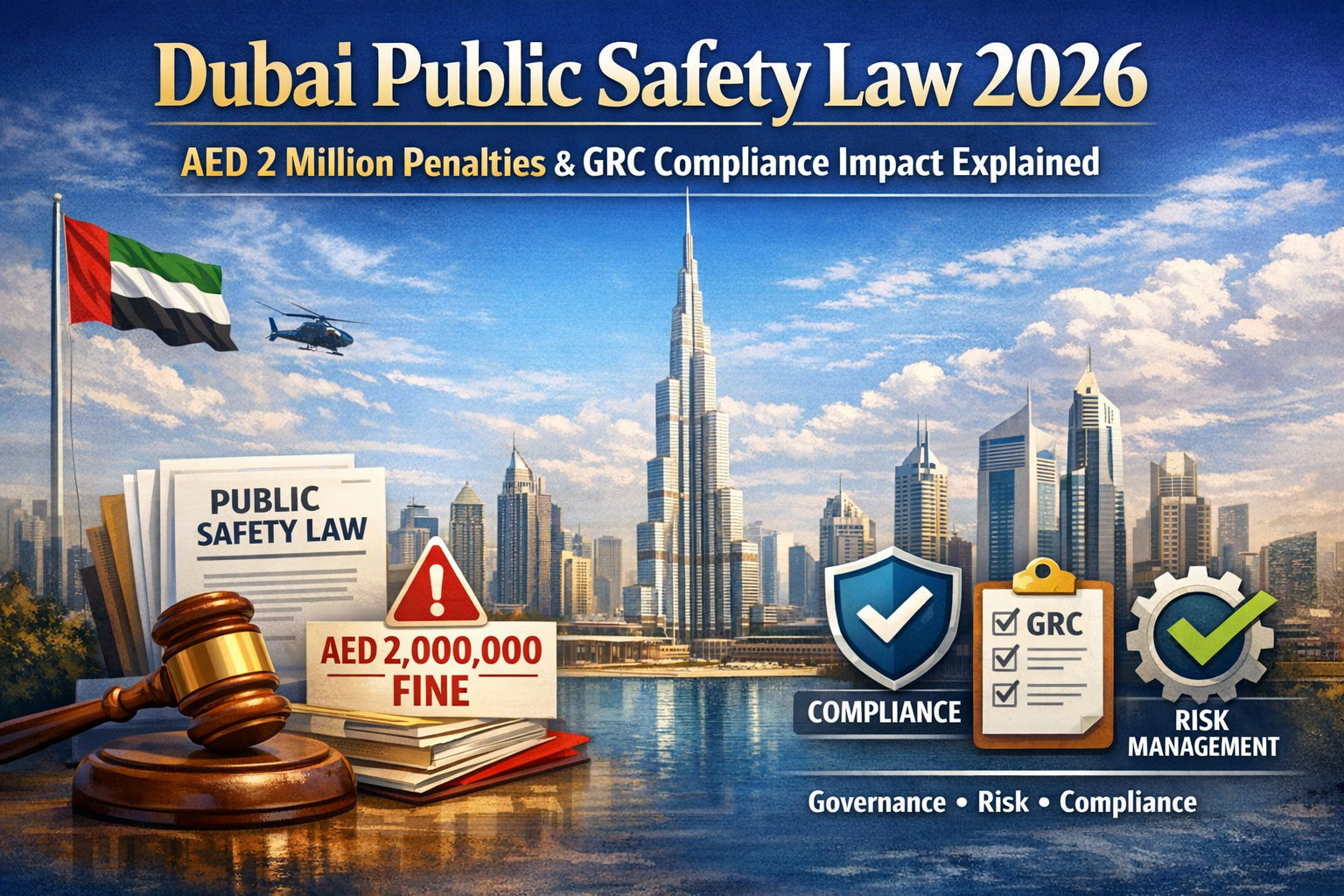
Dubai has taken a decisive regulatory leap with the introduction of Law No. (2) of 2026 on Public Safety, issued under the leadership of Sheikh Mohammed bin Rashid Al Maktoum. This law establishes a comprehensive safety governance framework across buildings, public venues, infrastructure, and events, signaling a major expansion of compliance beyond traditional domains. (The Times of India)
With penalties reaching AED 2 million, the law is not just regulatory, it is transformative for GRC (Governance, Risk, and Compliance) programs globally.
1. Why This Law Was Introduced (Reason for the Rule)
Dubai’s rapid urbanization, global tourism footprint, and large-scale infrastructure development have significantly increased operational and public safety risks.
Key Drivers:
- Protection of human life and public assets in high-density environments
- Rising complexity of public events and infrastructure systems
- Global positioning of Dubai as a safe, world-class destination
- Alignment with international safety and sustainability standards
The law establishes a centralized and enforceable framework to ensure safety compliance across all sectors, something previously fragmented across regulations. (Sharjah24 | الرئيسية)
2. Scope of the Law
The regulation is intentionally broad, covering:
- Buildings and construction environments
- Public venues and entertainment facilities
- Events and mass gatherings
- Infrastructure and public services
- Beaches and recreational areas
Organizations must now implement:
- Safety management systems
- Emergency preparedness plans
- Fire safety and evacuation protocols
- On-site trained safety personnel
- Compliance with environmental, health, and safety (EHS) standards (Emirati Times)
3. How This Law Will Help
a) Stronger Public Safety Outcomes
The law ensures proactive risk mitigation, reducing accidents, incidents, and emergency failures.
b) Standardization of Safety Practices
Creates a uniform compliance baseline across industries, eliminating inconsistencies.
c) Increased Accountability
Authorities now have clear enforcement powers, including inspections, violation reporting, and escalation to law enforcement. (International Fire & Safety Journal)
d) Improved Business Resilience
Organizations are forced to adopt structured safety governance, reducing operational disruptions and liability risks.
e) Trust & Reputation Enhancement
Higher safety standards directly contribute to:
- Investor confidence
- Tourism growth
- Global business attractiveness
4. Penalties & Enforcement
The law introduces a strict, tiered penalty framework:
- AED 500 to AED 1,000,000 for violations
- Up to AED 2,000,000 for repeat offences within one year (Government of Dubai Media Office)
Additional enforcement aspects:
- Authorities can record violations and initiate legal action
- Cases may be escalated to police involvement if required
- Organizations have the right to appeal within 10 working days (ARN News Centre)
This penalty structure clearly shifts compliance from optional to mandatory and enforceable.
5. GRC Impact: A Structural Shift
This law fundamentally reshapes GRC frameworks:
Expansion of GRC Scope
Traditional GRC focused on:
- IT security
- Financial compliance
- Regulatory reporting
Now it must include:
- EHS (Environment, Health & Safety)
- Operational safety risks
- Physical infrastructure risk management
Integration Requirement
- Safety controls into enterprise risk management (ERM)
- EHS into compliance frameworks
- Real-time monitoring and incident response
Board-Level Visibility
Safety is no longer operational, it becomes a strategic governance issue.
6. Key Challenges for Organizations
- Lack of mature EHS frameworks
- Siloed compliance functions
- Insufficient safety training and awareness
- Inadequate incident response planning
- Limited real-time monitoring capabilities
Organizations failing to adapt will face financial, legal, and reputational exposure.
7. What Organizations Should Do Now
Immediate Actions:
- Conduct a compliance gap assessment
- Implement or upgrade EHS management systems
- Define safety governance policies and SOPs
- Train employees and safety officers
- Deploy incident reporting and monitoring tools
Strategic Actions:
- Integrate EHS into enterprise GRC platforms
- Align with standards such as:
- ISO 45001 (Occupational Health & Safety)
- ISO 31000 (Risk Management)
- Establish continuous compliance monitoring
8. Key Takeaways
- Dubai’s Public Safety Law (2026) is a major regulatory milestone
- Compliance now extends beyond IT and finance into physical and operational safety
- Heavy penalties (up to AED 2 million) create strong enforcement pressure
- EHS is now a core pillar of GRC frameworks
- Organizations must shift from reactive compliance → proactive risk management
Final Thought
This law is not just about safety, it represents a broader regulatory philosophy shift:
“Compliance is no longer about avoiding penalties; it is about building resilient, safe, and trustworthy systems.”
For organizations operating in Dubai (or planning to), this is a clear signal:
Integrate safety into your core governance model, or face significant consequences.
For all our Blogs you may refer to our Blog pages at:
Blog – Friggenix Solution and Blog – Frigg Business Solutions
Need help understanding the Legal Penalties, Criminal Liability, Board-Level Accountability, and Corporate Exposure?
We at Friggenix Business Solution and Frigg Business Solutions offer specialized services to conduct precise Privacy Risk Management compliance gap analysis and and help in implementing the Privacy framework that meets the specific business and regulatory needs.
Contact us today to ensure your business is not only secure but also demonstrably compliant. Schedule a confidential assessment to discuss practical, risk-aligned mitigation strategies tailored to your industry and regulatory environment.
You can send an email to us at: info@friggenix.ae or service@friggp2c.com
Call us on: +971 58 137 9867 | +971 54 489 2599 | +91 733-113-2288 | +1 (905) 261-9123 | +1 (905) 261-9124
Smart Compliance for a Secure Tomorrow
About the Authors
Amit Sarkar
Amit Sarkar (amit.sarkar@friggenix.ae) is the Founder of Frigg Business Solutions and now Friggenix Business Solution – FZCO in Dubai, UAE, in the USA, Canada, and India. He advises boards and regulators on AI governance, privacy compliance, cybercrime compliance, and executive liability under UAE and global regulations. A seasoned writer whose multiple articles have been published in HCCA and SCCE. He is a former CEO of a US Healthcare Regulatory Compliance service organization, and a senior global leader in GRC, IT Security, Privacy Compliance, Risk Management, HIPAA Compliance, SOC 2 Type II, and a Global Lead Auditor in multiple ISO standards.
LinkedIn: Amit Sarkar | LinkedIn