UAE Cybersecurity Landscape: Regulations, Authorities & What Businesses Must Know:
Navigating the UAE Cybersecurity Rulebook: A Practical Guide for Businesses-
The United Arab Emirates is an international leader in digital transformation, but this rapid adoption of technology comes with a complicated and developing cybersecurity landscape. For businesses operating in the UAE, compliance isn’t just a recommended practice—it’s a mandatory legal requirement enforced by various authorities.
The UAE’s dual regulatory structure—a federal framework controlling the mainland nation and separate, sometimes extremely detailed systems within the Financial Free Zones—presents a problem. This guide gives you an in-depth review of the authorities, the main regulations, and the specific steps you need to take to guarantee compliance.
Understanding where your business falls is the first and most critical step. Your regulatory obligations are determined by your location and sector.
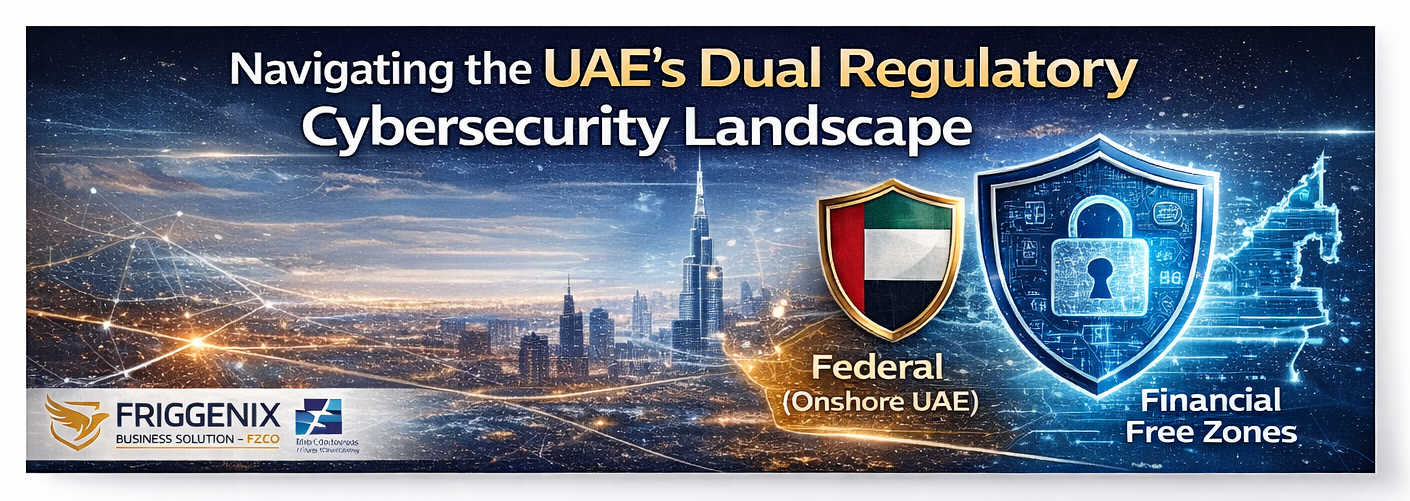
1. Federal (Onshore UAE)
| Authority | Key Legislation / Focus | Scope / Affected Entities |
|---|---|---|
| UAE Cybersecurity Council | Sets the National Cybersecurity Strategy and policies, including the National Information Assurance Framework (NIAF) and the National Cloud Security Policy (2023). | Government organizations, establishes national standards, provides protection for Critical Information Infrastructure (CII). |
| Federal Decree Law No. 34 of 2021 | On Combating Rumors and Cybercrimes. Broadly defines and penalizes cyber offenses like hacking, fraud, data theft, and unauthorized access. | All individuals and businesses operating in the UAE. |
| Federal Decree Law No. 45 of 2021 (PDPL) | On Personal Data Protection. The UAE’s first comprehensive data protection law, establishing rights for data subjects and obligations for controllers/processors. | All businesses that process personal data (with some sectoral and Free Zone exemptions). |
| Telecommunications and Digital Government Regulatory Authority (TDRA) | Regulates the ICT and telecommunications sectors and issues guidelines on consumer data protection. | Telecom operators and businesses utilizing ICT services. |
2. Financial Free Zones (FFZs)
These zones—most notably DIFC and ADGM—operate their own legal and regulatory systems, including data protection and cybersecurity rules, which are generally more aligned with global standards like the EU’s GDPR.
| Authority | Focus / Key Framework | Specific Compliance Angle |
|---|---|---|
| DFSA (Dubai Financial Services Authority) in DIFC | General Rulebook (GEN) and DIFC Data Protection Law 2020. Principles-based and governance-centric. | Firms must adopt recognized cybersecurity frameworks (e.g., NIST, ISO 27001) and demonstrate governance maturity and resilience. |
| FSRA (Financial Services Regulatory Authority) in ADGM | Cyber Risk Management Framework (CRMF) and ADGM Data Protection Regulations 2021. Focuses on enterprise-level risk and third-party vendor management. Highly focused on third-party accountability, mandating detailed contract clauses and audit rights for ICT vendors. | Highly focused on third-party accountability, mandating detailed contract clauses and audit rights for ICT vendors. |
| VARA (Virtual Assets Regulatory Authority) in Dubai | VARA Rulebook. Highly specific technical standards for Virtual Asset Service Providers (VASPs). | Most technically prescriptive, requiring stringent cryptographic key management (wallet segregation, cold storage), smart-contract audits, and DLT security. |

Recent Regulatory Shifts Every Business Should Know-
The UAE is rapidly raising its cybersecurity standards — and businesses can’t afford to overlook these changes:
-
Tougher Penalties Under Law 34/2021:
The Cybercrimes Law now covers a wider range of digital offenses and enforces tougher penalties. Any breach involving personal data, electronic fraud, or unauthorized access can result in severe consequences.
-
PDPL: More Rules on Data & Consent:
As the PDPL rolls out, companies must upgrade how they handle data and obtain user permissions. Regulators now expect:
- Full opt-in consent for all non-essential cookies.
- Cookie banners available in both Arabic and English.
- Sensitive data to be stored on UAE-compliant infrastructure.
-
Stronger Frameworks in ADGM & VARA:
- ADGM’s 2026 cyber rules require ongoing vulnerability checks and regular pen-testing.
- VARA’s rulebook makes crypto-native security — from wallet safety to smart contract reviews — a core part of compliance.
Practical Steps for Compliance: What Your Business Must Do-
Achieving compliance isn’t a one-off project — it requires continuous oversight and operational discipline. Below are the essential actions every organization should prioritize:
1.Understand Your Jurisdiction and Regulatory Obligations
-
Identify Your Governing Authority:
Determine whether your business falls under federal UAE laws, a specific free zone (such as DIFC or ADGM), or a combination of both. This defines which regulatory framework and cybersecurity standards apply to you.
-
Perform a Compliance Gap Assessment:
Compare your existing controls, policies, and technical safeguards against the requirements set by your regulator — whether that’s NIAF obligations, DIFC GEN module expectations, or VARA’s crypto key-management rules.
2.Strengthen Governance and Technical Safeguards
-
Adopt a Recognized Cyber Framework:
Implement a global standard like ISO 27001 or the NIST Cybersecurity Framework, then map and adapt it to UAE regulatory obligations.
-
Enforce Secure Access & Encryption:
Encrypt all sensitive data both at rest and in transit. Apply Multi-Factor Authentication (MFA) across critical applications and ensure user permissions follow the Principle of Least Privilege.
-
Manage Third-Party Risks:
For regulated sectors such as ADGM or DFSA, maintain a rigorous vendor assessment process. Ensure ICT partners provide contractual assurances covering audit rights, data location, and compliance with your regulatory duties.
3.Strengthen Data & Website Compliance
-
Upgrade Consent Collection Processes:
Rework website cookie banners and consent forms to capture explicit, revocable user consent — presented in both Arabic and English — in line with evolving PDPL enforcement.
-
Apply Data Localization Where Necessary:
Review your data categories. If your organization handles regulated health, financial, or sensitive information, ensure storage and processing occur within UAE-approved data centers or compliant jurisdictions.
4.Build Incident Response Readiness
-
Develop & Test an Incident Response Plan:
Establish a clear playbook covering detection, containment, eradication, and recovery procedures. Conduct periodic tabletop exercises to validate readiness.
-
Understand Reporting Timelines:
Each regulator has strict notification deadlines. ADGM and DFSA, for example, often require disclosure of a significant incident within 24 to 72 hours. Ensure your teams know who must report, when, and to whom.
Need help mapping where your business falls? We can map your regulatory obligations-
The complex interplay between federal laws, sector-specific mandates, and Free Zone regulations can be overwhelming. Friggenix Business Solution – FZCO and Frigg Business Solutions offer specialized services to clarify your position, conduct a precise compliance gap analysis, and build a cyber framework that meets your specific UAE regulatory needs.
Contact us today to ensure your business is not just secure, but demonstrably compliant, and schedule a confidential assessment and discuss practical, risk-aligned mitigation strategies tailored to your industry and regulatory environment.
Contact our experts at: www.friggenix.ae | info@friggenix.ae | +971 54 489 2599 | +971 58 137 9867 | +91 733-113-2288
Let’s secure what’s exposed—before it’s exploited.
About the Authors
Amit Sarkar
Amit Sarkar (amit.sarkar@friggp2c.com) is the Founder of Frigg Business Solutions across at Sheridan, Wyoming, USA, and Hyderabad, Telangana, India. A seasoned writer whose multiple articles have been published in HCCA and SCCE. He is a former CEO of a US Healthcare Regulatory Compliance service organization, and a senior global leader in HIPAA Compliance, IT Security, Risk Management, and Compliance Governance.
LinkedIn: Amit Sarkar | LinkedIn